
Confidential Files - From Litter Boxes to Literal Bucks
In-depth analysis on The Birth of Cat-astrophic Success

Picture this: You wake up one morning, look at your complete lack of artistic talent, and instead of signing up for drawing classes or accepting your fate as a stick-figure peasant, you think, "You know what? I'm going to monetize this disaster."
That's exactly what Steve Gadlin did in 2011 when he launched "I Want to Draw a Cat For You" – a business so brilliantly simple it makes you question everything you thought you knew about entrepreneurship. While art schools were teaching perspective and shading, Steve mastered the only technique that mattered: drawing cats so laughably bad that people happily paid for the privilege of owning them.
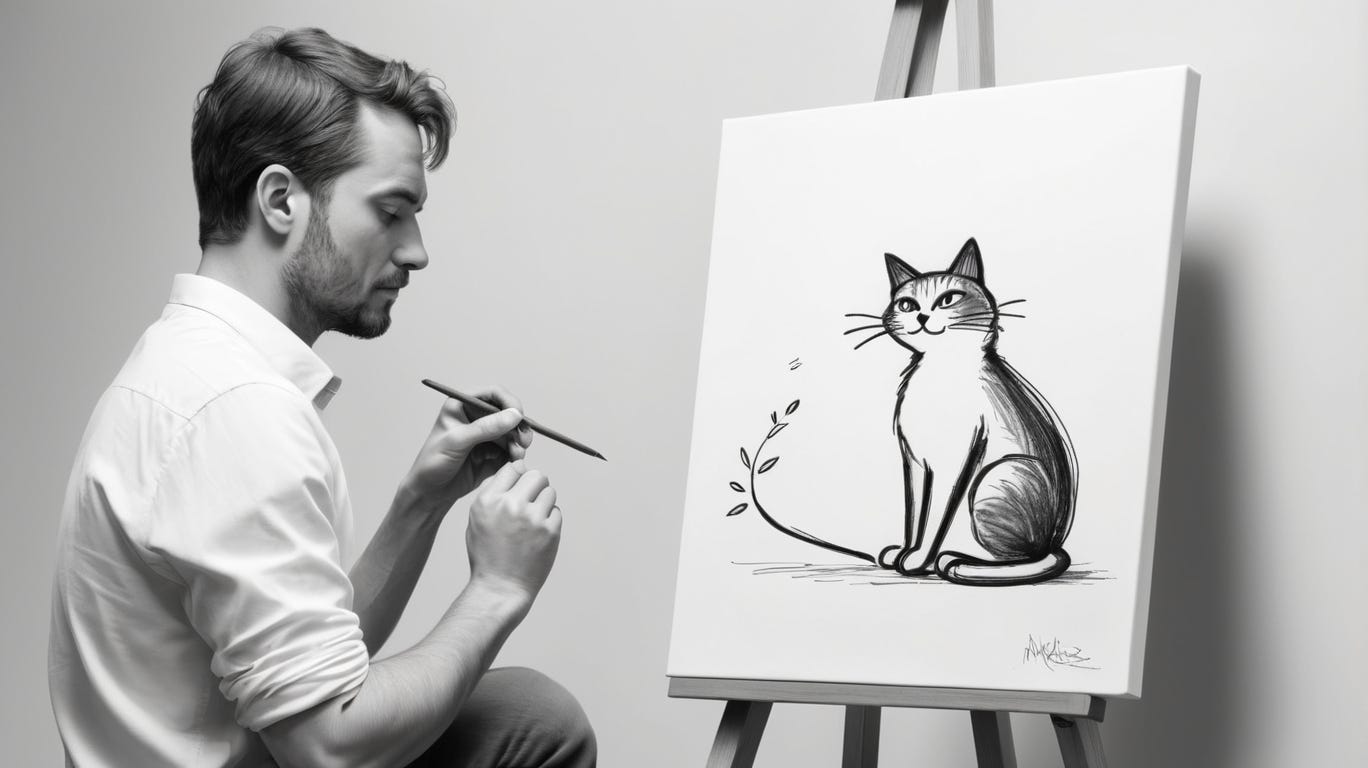
His cats didn't just look bad – they looked like they'd been drawn by someone wearing oven mitts. And people couldn't get enough of them. Each five-minute masterpiece sold for $5, creating what might be the most efficient terrible-art-to-cash conversion rate in human history.
This isn’t just a viral fluke or Shark Tank punchline. It’s a masterclass in how strange ideas, when executed right, can purr their way into profitability. In this follow-up deep dive, we’ll break down how Steve turned one of the internet’s quirkiest ideas into a real business—and how you can apply the same logic to your own wacky, brilliant concepts.
Business Model Breakdown: Sketching the Purr-fect Revenue Stream
For $5, customers would describe what they wanted their cat to be doing, and Steve would deliver a custom drawing that looked like abstract art had a head-on collision with a kindergarten finger painting. The beauty was in the promise: these weren't going to be good. They were going to be spectacularly, memorably, hilariously bad.
The Economics of Awful
Production time: 5 minutes per cat
Price per cat: $5
Effective hourly rate: $60
Materials needed: Paper, pen, scanner (total investment: probably under $50)
Overhead: Essentially zero
Scalability: Limited only by his drawing stamina and internet bandwidth
This created a business with profit margins that would make Apple jealous. No inventory, no complex supply chains, no employees (initially), and no need for expensive equipment or training. Just pure, distilled entrepreneurial audacity.
Let’s not forget the upsells: colors, shipping, and even celebrity-style shout-outs. Gadlin didn’t just draw cats—he built an experience.
Big Entrepreneurial Learnings: The Cat's Out of the Business Bag
Ok. I will stop with the cat puns now. I promise.
Embrace Your Limitations as Your Differentiator
Steve's complete inability to draw wasn't a bug – it was the feature. In a world where everyone tries to hide their weaknesses, he weaponized his. This teaches us that sometimes our biggest "flaws" can become our strongest competitive advantages.
Book Recommendation: "Purple Cow" by Seth Godin
Price for Value, Not Cost
Steve charged $5 for five minutes of work, creating a $60/hour business. He didn't price based on his costs (minimal) or time investment (tiny) – he priced based on the value customers received: a unique, personalized, shareable experience that brought joy and laughter.
This is pricing psychology 101. Customers weren't buying cat drawings; they were buying entertainment, stories to share, and a connection to something genuinely unique on the internet. The physical drawing was just the vessel for delivering that experience.
Book Recommendation: "Priceless: The Myth of Fair Value" by William Poundstone
Authenticity Beats Perfection in the Digital Age
In an era of Instagram filters and Photoshop perfection, Steve's authentically terrible cats were like a breath of fresh air. They were real, imperfect, and human in a way that connected with people on an emotional level.
His success proved that audiences crave authenticity. People were tired of perfection and hungry for something genuine, even if genuinely awful.
Book Recommendation: "The Cluetrain Manifesto" by Rick Levine
Turn Constraints into Creative Catalysts
Most people would see "can't draw" as a barrier to starting an art business. Steve saw it as his unique selling proposition. He turned a limitation into liberation – since he couldn't draw well, he was free to draw terribly with complete confidence.
This constraint actually made his business more defensible. Anyone could try to copy him, but nobody could replicate his specific brand of terrible. His limitation became his moat.
Book Recommendation: "A Beautiful Constraint" by Adam Morgan and Mark Barden
Understand Your Real Product
Steve wasn't really selling cat drawings – he was selling joy, shareability, and a story people could tell. Understanding this distinction allowed him to price appropriately, market effectively, and eventually expand beyond cats.
Too many entrepreneurs get caught up in the features of what they're making instead of the benefits they're delivering. Steve's customers weren't buying terrible art; they were buying entertainment and social currency.
Book Recommendation: "Jobs to Be Done" by Tony Ulwick

The Tail End of a Purr-fect Business Story
I’m sorry. I couldn’t stop myself.
Steve Gadlin's journey from artistically challenged individual to cat-drawing entrepreneur isn't just a quirky internet success story – it's a masterclass in unconventional business thinking. In a world that tells us we need to be the best at something to succeed, Steve proved that being memorably, authentically terrible can work just as well.
The deeper lesson here isn't that everyone should start drawing terrible cats (though the market might have room for terrible dogs, hamsters, or existentially confused goldfish). It's that success often comes from zigging when everyone else is zagging, from finding the joy in imperfection, and from understanding that people don't always want the best – sometimes they want the most authentic, the most human, or the most entertaining.
So, to all the would-be entrepreneurs out there: Maybe your idea feels ridiculous. Maybe your friends don’t get it. Maybe your business plan fits on a napkin next to a badly drawn cat.
That might be exactly why it will work.
After all, Steve didn't just build a business – he built a monument to the idea that sometimes, being perfectly imperfect is perfectly perfect. And if that's not worth $5, what is?
So, Go ahead and draw your cat.
Further Investigation
What’s Next ?
New Post Dropping - 3 June 2025
The Bark Side of Business (The Visionary Behind Canine Couture)